Avaliação Qualis Capes - Quadriênio 2017-2020

Qualis B1
Contato

Scientific articles, literature review articles, case reports, short communications, and other articles that are related to the journal's disclosure objectives will be accepted for evaluation by the editorial/consultative committee, being one of the authors with the title of master or doctor. The material is sent to the consultants and reviewers, who will decide on the convenience of the publication, in full or in part, forwarding suggestions and possible corrections to the author. The JRG Journal of Academic Studies adopts as evaluation policy the "double blind peer review" system, promoted by members of its body of evaluators, registered in the site of the journal. Texts submitted undergo an initial formal evaluation by the editorial team, which may request corrections and additions. Texts that do not fit the scope of the journal, that do not meet mandatory requirements will be filed.
3.1 The publication of the articles is submitted to the double blind peer reviewprocedure.
3.2 The works are sent without identification of authorship to two "ad hoc" referees with a doctoral degree, linked to JRG Journal of Academic Studies
3.3 In case of controversy between the evaluators, the article is submitted to a third evaluator.
3.4 The referees are always Doctors affiliated to renowned national and foreign higher education institutions.
3.5 The criteria used in the evaluation form are the following:
Contato
INDEXADORES / INDEX



























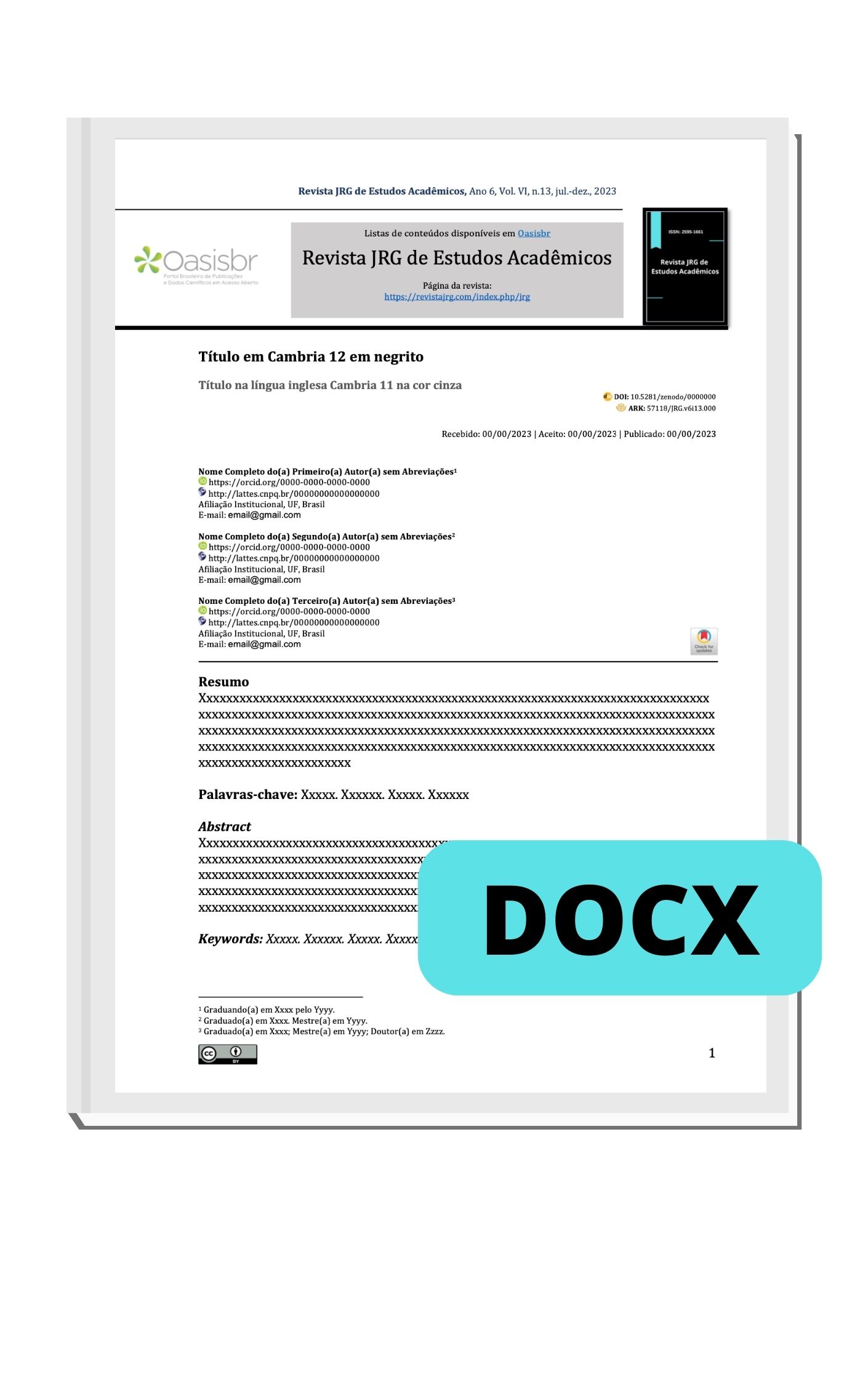
Template


QR - Capes Periódicos

ISSN: 2595-1661
 This Journal is licensed under a Creative Commons License - Attribution 4.0 International.
Google Metrics: Median h5: 6.0
ICDS = 3.0
ISSN Online: 2595-1661
Email: professorjonas@gmail.com
Tel: +55 (61) 99204-5557
CNPJ: 30.152.162/0001-06
Address: Avenida das Araucárias 4400, Águas Claras, Distrito Federal, Brasília, Brazil.
CEP: 7193-6250